
Thinking of Renovating or Rebuilding, But Don't Know Where to Start?
The first post in our Building Made Simple series, where we take the jargon out of designing and building a family home.
Most people who come to us with a renovation or a new build have been thinking about it for a long time. There's a picture in their head of the finished home. What they don't have is a clear sense of how you actually get there, or what happens first.
If that's you, you're in good company. The path from "we think we want to do this" to "we're living in it" has a few clear phases, and once you can see them laid out, the whole thing feels a lot less daunting. So here's the journey, start to finish, in plain English.
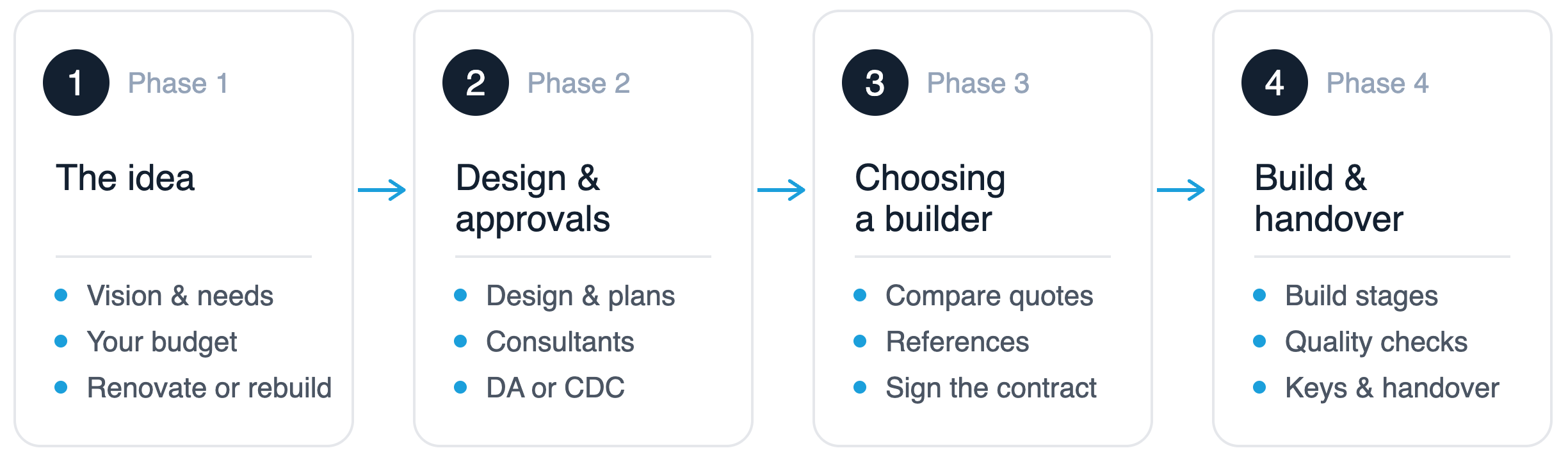
Phase one: the idea
Every build starts as an idea, and this early stage is worth more time than people give it.
This is where you get clear on what you actually want. How your family lives now and how you want to live in a few years. What's not working about your current home. The rooms and spaces you can't do without, and the ones that would be nice but aren't deal-breakers. It's also where you get honest about budget, because that shapes everything that follows.
If you already own the home, one of the big questions here is whether to renovate and extend what you've got, or knock down and rebuild. There's no single right answer. It comes down to your home, your block, your budget and what you're trying to achieve. A good builder or designer can help you weigh it up early, before you've spent money heading down the wrong path.
By the end of this phase you should have a rough brief: what you want, roughly what you're willing to spend, and a sense of direction.
Phase two: design and approvals
Once you know what you want, it needs to be designed and approved before anyone can build it.
This is where your architect or building designer takes your brief and turns it into a proper design and a set of plans. Along the way, other specialists usually get involved, engineers, surveyors and the like, each looking after their part of the puzzle. (We'll break down who all these people are in the next post.)
Then the plans need approval. In NSW that's usually either a Development Application through council, or a faster track called a Complying Development Certificate if your project fits the rules. Either way, you can't start building until you're approved.
This phase takes longer than most people expect, so it pays to be patient here. Getting the design and approvals right is what makes the build itself run smoothly.
Phase three: choosing a builder
With a design in hand, you choose who's going to build it. This is one of the most important decisions you'll make, and it's about more than just the price.
Cost matters, of course. But a home is a long project, and you'll be working closely with your builder for months. How they communicate, how they handle problems, whether they're upfront with you, that's what determines whether the experience is a good one. Talk to their past clients. Ask how they deal with the unexpected, because something always comes up. Make sure the quote is genuinely comparing like with like.
Once you've chosen, this is also where the contract is signed. A clear contract protects both sides and sets out exactly what's being built, for how much, and over what timeframe.
Phase four: construction and handover
Now the building actually happens. This is the phase people picture when they think about building, and it's where the plans finally become a home.
Through the build, work moves through stages, from the slab and frame up to the finishes and fit-out. A good builder keeps you informed as it goes, so you always know what's happening and what's coming next. Along the way an independent certifier checks the work at key points to confirm it meets the approval and the building code.
At the end comes handover. The final checks are done, any defects are sorted, the certifier issues the occupation certificate that says your home is ready to live in, and you get the keys. A considerate builder doesn't just disappear at this point either, they'll walk you through your new home and be there for the maintenance period that follows.
The simple takeaway
Building a home has four clear stages: get clear on the idea, design and get it approved, choose the right builder, then build and hand over. It's a journey, but a well-mapped one.
You don't have to have it all worked out before you pick up the phone. Often the best first step is a straightforward conversation about what you're thinking, so you can figure out which phase you're really at.
Over the rest of this series, we'll unpack each of these stages in more detail, starting with the team of people who help bring a home to life.
Thinking about a renovation or a new build and not sure where to begin? That first chat is free and comes with no pressure. Get in touch and we'll help you find your starting point.